Wednesday, July 29, 2015

AICTE affiliation system needs to end in 10 years, says govt panel

AICTE affiliation system needs to end in 10 years, says govt panel

Panel suggests single engineering entrance exam for all schools under AICTE and a single management test for all business schools
 
A government panel has recommended converting the All India Council of Technical Education (AICTE) into a statutory constitutional body and suggested ending the affiliation system of technical schools in the next 10 years.
 
The panel has recommended that the AICTE should evolve as a mentor rather than a “policeman”.
 
Recognizing the “need for restructuring and strengthening” the AICTE to address challenges, the human resource development ministry set up a review committee led by former education secretary M.K. Kaw in November 2014.
 
More than 11,000 professional schools, including engineering and management schools, fall under the purview of the AICTE.
 
The panel’s report called on the regulator to shed the mindset of a licence distributor and suggested some radical steps, including doing away with the affiliation system in a decade, conducting a single engineering entrance exam for all schools under AICTE and a single management test for all business schools.
 
The Indian Institutes of Management (IIMs) and Indian Institutes of Technology (IITs) do not fall under the AICTE’s purview.
 
The government panel’s report said, “AICTE should be recognised as the chief instrument of state policy in order to establish India as the technical education superpower of the world. It should be converted into an apex constitutional authority to promote orderly, integrated and coordinated development of technical education... technical education should be a fundamental right”.
 
The recommendations hold significance in the face of growing suspicion over the AICTE’s role as a regulator and its conflicting role along with the University Grants Commission. A case is also on in the Supreme Court on whether it qualifies as a technical education regulator at all.
 
“It has to get converted into a facilitating agency which promotes technical education... through suitable schemes of mentoring and guidance, faculty improvement, development of research and incubation infrastructure, grant of financial assistance to deserving institutions... and so on”, the report said.
 
On the growing number of new institutions, the panel said, “New institutions should be allowed only if there is substantial unmet demand pertaining to an area of specialisation.”
 
The panel suggested that third-party ratings should be used as the “fulcrum of regulation” and that “norms shall measure outcomes rather than be obsessed with physical inputs alone”.
It asked the AICTE to improve the functioning of sub-standard institutions with help from “senior faculty drawn from higher technical institutions who will act as mentors and trainers”.
H. Chaturvedi, director of the Birla Institute of Management and Technology in Greater Noida, said he supports the suggestions of making the AICTE a statutory constitutional body like the Election Commission.
 
He added that instead of the National Board of Accreditation carrying out the accreditation of courses, the government needs to take the help of competent industry bodies for better outcomes.
 
Source | Mint – The Wall Street Journal | 29 July 2015

Sunday, August 24, 2014

AICTE-Librarian-Pay Scale

http://www.aicte-india.org/downloads/reg-paydegree220110.pdf


Saturday, April 26, 2014

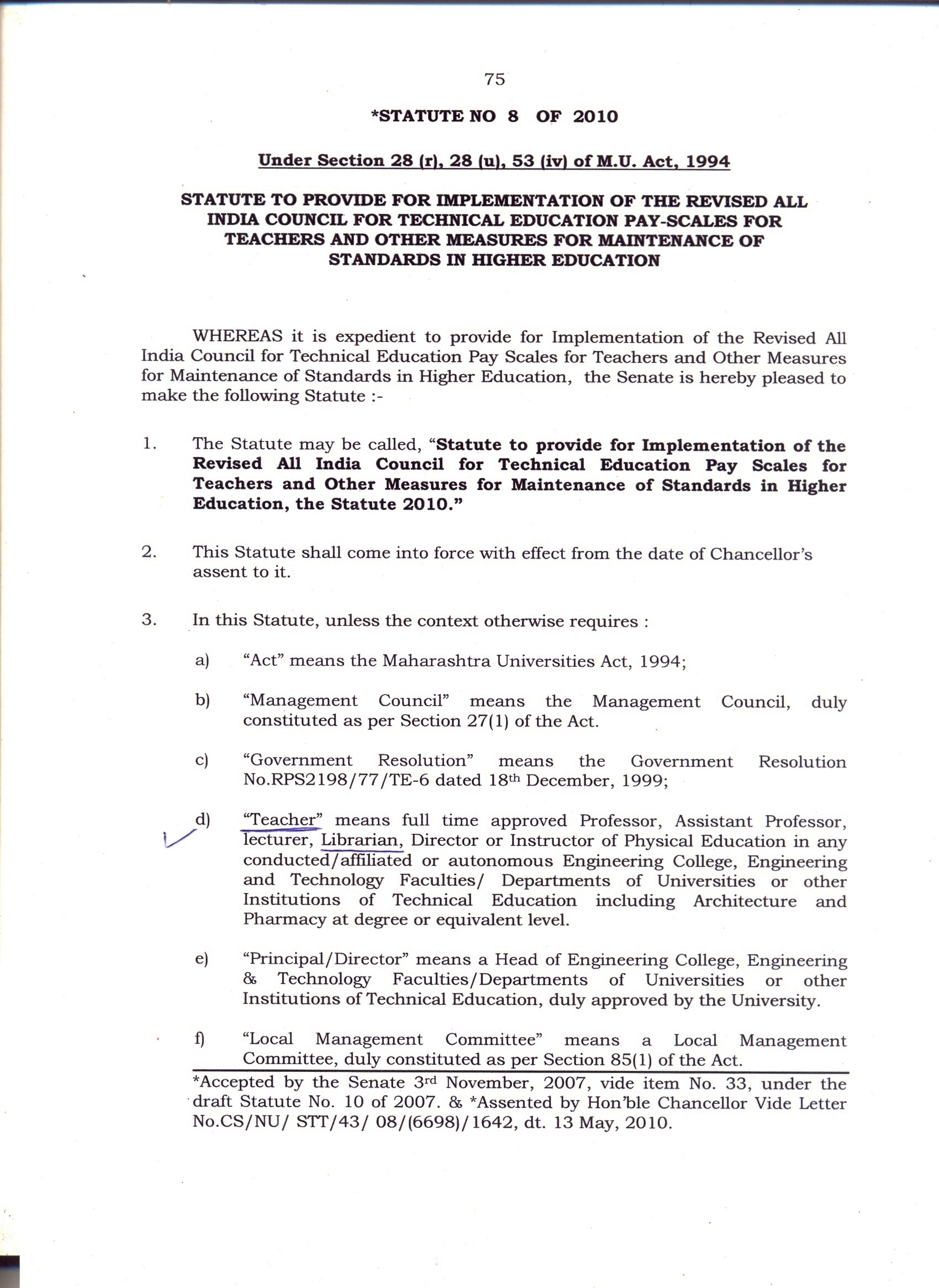
Librarian as teacher by AICTE


https://01415553475663648847.googlegroups.com/attach/1416cae7b5ec8c51/AICTE%20Librarian%20-%20teaching.jpg?part=4&view=1&vt=ANaJVrEPYd-cG15tvI_1400J5aQ0oX4mMQSYJ197HHShYEJTstJBPgOhM-WlyuNNQBLT3rdSV_Bvwt7Tte5nBLu6ip91cHyXJqVPKzDV2HqTxm3ALzUa9xQ


https://www.facebook.com/pages/Information/150388575132752

Wednesday, April 23, 2014

SC gives back AICTE power to approve tech colleges

1)SC gives back AICTE power to approve tech colleges

Link: 


2)Apex court lets AICTE to approve technical institutes

Link: 


Apex court lets AICTE to approve technical institutes
Arun P Mathew,TNN | Apr 20, 2014, 03.34 AM IST
COIMBATORE: The Supreme Court has given an interim order that the All India Council for Technical Education (AICTE) will be in charge of the approval process of technical institutions for the coming academic year as well. An interim order issued on Thursday by the court says the AICTE can proceed in accordance with its Approval Process Handbook.

"Approval Process Handbook (2013-14) is presently in force and the same has been extended and made applicable for the Academic Year 2014-15 as well. AICTE shall now proceed in accordance with the Approval Process Handbook for the Academic Year 2014-15. Necessary orders shall be issued by AICTE within 10 days," said the order issued by the bench of justices L M Lodha and Kurien.

AICTE officials said they were studying the order and added that they would continue with their policies. "If we are given back approval powers we will not keep any restrictions with regard to starting technical institutions," said S S Mantha, chairman of AICTE. The liberal allocation of technical institutions was one of the policies that has been heavily criticised. Mantha's words indicate a continuity of the policies if AICTE gets back the powers.

Former Anna University vice chancellor E Balagurusamy said the order was a heartening development and added that AICTE was doing a commendable job and expected the agency would get complete powers over technical and management institutions as before.


SC gives back AICTE power to approve tech colleges
Ashok Pradhan,TNN | Apr 21, 2014, 02.18 PM IST

BHUBANESWAR: Changing its decision of April 25 last year, the Supreme Court has allowed All India Council for Technical Education (AICTE) to have regulatory control over technical educational institutions in the country for the 2014-15 academic year. The latest interim order came on a petition of the Odisha Technical Colleges' Association (OTCA) on April 17, OTCA president Biswajit Mohanty said here on Sunday.
The SC last year had said colleges affiliated to any university do not come under AICTE purview, thereby shrinking AICTE role in regulating technical institutions. After the April 25 SC order, the University Grants Commission (UGC) had decided to take over control on technical education in the country and had framed guidelines for universities.

Allowing AICTE to have regulatory control over all such technical institutions again, a bench of Justice R M Lodha and Justice Kurian Joseph said on April 17, "AICTE shall now proceed in accordance with the approval process handbook for the 2014-15 academic year in so far as members of the petitioner association and all colleges and institutions situated similarly to the members of the petitioners' association."

The apex court also asked AICTE to issue necessary orders in this regard within 10 days, copy of the court order reveals.

Welcoming the latest court verdict, the OTCA president said AICTE control over technical institutions is necessary to ensure quality in technical education.

"UGC being an agency to offer grants, it had no technical expertise to ensure norms in technical institutions. That is why UGC delegated such a role to universities, which will dilute the quality of technical institutions in the country," Mohanty told TOI.

OTCA, which has 62 member colleges in the state, had prayed to vest regulatory control on AICTE on the same logic.

The colleges were particularly apprehensive about their future without AICTE. In the UGC system, regulatory powers would have ultimately come to state universities, resulting in increased state government meddling in their affairs. The Odisha government, for example, had asked UGC to ensure that only Biju Patnaik University of Technology (BPUT) be allowed to affiliate any technical institution in Odisha.
The government had also requested UGC to ensure that no objection certificate from the state government would be made necessary before opening a new technical college, change of location, closure of a college and conversion of women's technical college into co-ed college etc.

Tuesday, January 28, 2014

UGC takes over reins of technical institutes


The Times of India
Description: The Times of India
Education

http://articles.timesofindia.indiatimes.com/2014-01-27/news/46684209_1_technical-institutes-law-ministry-aicte-act

UGC takes over reins of technical institutes

Akshaya Mukul, TNN Jan 27, 2014, 05.10AM IST

NEW DELHI: University Grants Commission's takeover of All India Council for Technical Education (AICTE) is complete as far as degree-granting technical institutes are concerned. UGC has formally notified the regulations to be followed by technical institutes affiliated to universities.
UGC's regulations come in the wake of a Supreme Court order which negated AICTE's power to grant approval to technical colleges affiliated to universities. With new regulations in place, it is unlikely that AICTE's hope of getting its power restored through amendment of AICTE Act will be realized anytime soon. But AICTE can continue to regulate diploma-granting institutions.
Description: http://timesofindia.indiatimes.com/photo/29432057.cms
"Chances of getting AICTE Act amended is remote. The next session of Parliament will be short and then there is general election," an HRD ministry official said.
As the amendment route was getting delayed, HRD ministry tried to circumvent the SC order by asking law ministry "if rules can be notified under section 25 of the UGC Act to authorize AICTE to accord approval to technical education institutions in the same manner as it did prior to the SC judgment". However, the law ministry shot down the proposal.
UGC regulation makes it mandatory for a college to first seek affiliation from the university before starting academic activities. A new college proposing to offer technical education can be created by introducing one or more programmes housed either in one or separate buildings.
The new college shall be granted affiliation when it is on one contiguous plot of land except for those in north-eastern and other hilly states where it can spread into three pieces of land, not far from one another, by more than one kilometer.
Apart from a host of regulations, technical institutes will have to keep 50% faculty from general shift for the evening shift. Each part-time course will be managed by 20% core staff i.e. minimum one associate professor and two assistant professors. Guest faculty should not be more than 30% to be sourced from neighbouring industries/R&D organizations/government technical colleges.


Tuesday, January 14, 2014

B-schools welcome compromise between UGC and AICTE

Logo


Wednesday, January 15, 2014 | 01:00 PM IST

The decision was taken after a Supreme Court order had left AICTE in the role of an advisor, a shift from being a regulator earlier


UGC comes up with new regulations

UGC comes up with new regulations

INDIA TODAY ONLINE  NEW DELHI, JANUARY 13, 2014 | UPDATED 19:24 IST

The University Grants Commission (UGC) has passed new regulations related to technical education and distance education.
At a meeting of the commission, as per the newly passed regulations, technical colleges will now be regulated by the Universities.
According to the new regulation, the universities have been empowered to grant recognition and approval to the colleges that offer engineering programs leading to an award of a degree.

As per the sources, before granting the approval, the universities need to develop their own mechanism for screening of proposal and inspection of Institution. The sources, however, added that the institutes that are offering a diploma in management programs will continue to be regulated as per the existing practices.

Also the regulation for distance education has been approved. As per this regulation, the universities that offer distance education programs will have to seek approval of UGC for programs leading to the award of a degree.
However, stand-alone institutions will most probably not be covered by the regulation.

About University Grants Commission (UGC):

It is a statutory organization set up by the Union government in 1956, charged with co-ordination, determination, and maintenance of standards of university education. It provides recognition to universities in India and disburses funds to such recognized universities and colleges. 

Friday, January 10, 2014

UGC not to regulate autonomous B-schools

http://www.livemint.com/Politics/1xeVZ5JNt1XvwoNB1G1oVO/UGC-not-to-regulate-autonomous-Bschools.html

          11 JANUARY 2014


UGC not to regulate autonomous B-schools

UGC chairman says all other professional colleges will have to abide by the new guidelines

UGC not to regulate autonomous B-schools
Independent B-Schools, which follow their own curriculum and set their own course fees, were also required to obey the guidelines and seek affiliation to universities that function under the UGC and adopt their syllabus. Photo: Indranil Bhoumik/Mint
New Delhi: Facing resistance from private colleges, the government has decided that guidelines unveiled last month for the oversight of technical institutes will not apply to autonomous B-Schools that have been concerned about losing their autonomy.
The draft guidelines were announced by the University Grants Commission (UGC) on 5 December and updated on 23 December to regulate all technical colleges after the Supreme Court on 25 April took them out of the regulatory purview of the All India Council for Technical Education (AICTE).
Independent B-Schools, which follow their own curriculum and set their own course fees, were also required to obey the guidelines and seek affiliation to universities that function under the UGC and adopt their syllabus.
Their inclusion provoked protests from administrators of these institutes, who argued that the quality of their courses, including the Post-Graduate Diploma in Management (PGDM) programme, would be compromised and the career prospects of their students harmed.
“We have withdrawn our guidelines to regulate PGDM schools,” UGC chairman Ved Prakash said. “Though we have made some progress, we have now decided to keep all diploma programmes out of our regulatory purview. Business schools providing PGDM will no more come under our supervision.”
“They will run as they used to be earlier,” Prakash said about the functioning of these B-Schools.
The UGC chairman, however, said all other professional colleges, including engineering schools, will have to abide by the new guidelines. On 10 January, the UGC and senior human resource development ministry officials are meeting to find ways to provide affiliation to over 11,000 professional schools.
Last month, several private education providers’ associations met human resource development minister M.M. Pallam Raju to express their reservations about the UGC draft guidelines.
India has more than 300 autonomous B-Schools including XLRI in Jamshedpur; Mudra Institute of Communications, Ahmedabad; International Management Institute in Delhi, and Management Development Institute (MDI) in Gurgaon. These autonomous B-Schools are also known as PGDM B-Schools because they don’t offer an MBA degree, but award a post-graduate diploma. They were operating without university affiliation but were approved by the AICTE.
Some 180,000 students are studying in these schools.
B-Schools said they hadn’t yet been informed about the government’s decision to spare them from having to follow the UGC guidelines.
“We have not received any formal communication from either the HRD (human resource development) ministry or the UGC about their withdrawal,” said Harivansh Chaturvedi, director of the Birla Institute of Management Technology in Greater Noida, on the outskirts of Delhi.
Chaturvedi, who is also the alternate president of the Education Promotion Society of India, said B-Schools were going ahead with their plan to meet the HRD minister again and explore judicial options.
Even if the UGC decides not to apply the new guidelines to autonomous B-schools, the institutes would still need to be overseen by a regulator, in the absence of which their status would remain uncertain.
Following the Supreme Court order, unless the government amends the AICTE Act, these schools cannot go back to the AICTE’s fold.
Without any regulatory body and government recognition, these PGDM schools will be required to pay a service tax to the government—which they don’t do currently. The legal validity of the degrees they award can be challenged and their students will not be eligible for education loans.
“We need a regulator and government recognition. We seek our legal status and autonomy,” Chaturvedi said.
Kumar Rajiv, a Delhi student who wants to join one of the top B-Schools, said the regulatory confusion needs to be cleared quickly before the admission process starts in a couple of months. “As a student, I would like to know the exact status of the school I am joining. If a B-School is unrecognized, I will hesitate to join it,” he said.


Tuesday, July 10, 2012

AICTE to establish one research park in each state


The All India Council for Technical Education has announced that it will help set-up research parks, one in each state, to promote research across industries. 
“The council would provide Rs 1 crore as seed money, while industry would have to provide a matching grant for the parks, to be set up on premises of an Institution, at least in a 3,000 square foot area,” said AICTE Chairman S S Mantha. 
“AICTE wanted such parks in every state, and the industry can form a cluster and do extensive research on their needs with the assistance of the selected institutions,” he added. 
Mantha said that in order to restore quality in higher education sector, there is a need to create a curriculum so that the sectors, higher education and industry, grow together to achieve the desired quality. 
Nandhini Rangaswamy, chairperson, Education Forum, CII Southern Region, said the industry chamber, in partnership with AICTE, has launched a survey of industry linkages of engineering institutes. 
Engineering institutes and engineering departments of the universities in six streams of Chemical, civil, computer and IT, electrical, electronics and communication and mechanical engineering are eligible to take part in the survey, she said. 
[Source: Zee News]

Wednesday, May 23, 2012

AICTE invites email complaints against colleges

The All India Council for Technical Education (AICTE) has invited stakeholders and outsiders to file a complaint against any technical education institution indulging in any wrongdoing via Email.
Any complaint or grievance regarding any institution or about the visit of experts assigned with specific tasks pertaining to the institutions can be brought to the notice of the AICTE through emails at aictevigilance@gmail.com.
According to AICTE officials, the vigilance awareness move will enable the governing body to have eyes at the grassroots, as well as get direct access to information that the institutions will never part with on their own.
“The AICTE aims to ensure that institutions function as per the norms and guidelines that they have undertaken to follow at the time of getting an approval. Often, institutions tend to find loopholes and bend the rules to their convenience. These transgressions are not brought to the AICTE’s notice until there is some major issue or disagreement between the institution and the students, staff or stakeholders,” said the official.
“This step has a dual effect. While on the one hand it will help us keep a tab on the functioning of the institutions, on the other it will also work as an avenue for feedback about the various initiatives that the AICTE undertakes to improve the condition of the students,” added the official.
[Source: Asian Age]

Friday, April 20, 2012

AICTE to launch academic website, job portal, research repository


In a first of its kind initiative, the All India Council for Technical Education (AICTE) will soon be launching academic networking site, along with a job portal and a repository of doctorate papers to check duplication and cheating.
The academic networking site proposes to interconnect 7.5 million students enrolled across AICTE-approved institutions linked through email IDs. The site will also have faculty and industry stakeholders on its database.
“The idea is to encourage academic networking and facilitate peer learning. That faculty will be accessible on this network, and help with course material, share charts, diagrams, data and projects that can aid learning, will make this an altogether knowledge building mechanism,” said the chairman of AICTE, SS Mantha.
The apex technical educational regulator is also working on ‘Project Factory’ - a repository aimed at capturing abstracts of all post graduate projects in an online bank. This data will be available to industry stakeholders and research labs so that those interested can easily contact the student concerned and take it forward.
“It will also help us check large-scale cheating and cut-copy-paste jobs that are seen in a number of research papers. A search engine on Project Factory will be able to quickly throw up abstracts of research works of interest to anyone,” Mantha added.
Meanwhile, in order to help students in gaining employment, AICTE will also put in place a job portal that proposes to store every student’s semester-wise results online and link it with his CV. This CV will automatically be forwarded to industry HRD heads whenever there is a vacancy suited to the student. This portal will be linked with an industry database of 8,000 stakeholders.
[Source: Indian Express]

Tuesday, April 17, 2012

AICTE signed an MOU with Microsoft: Download Software


AICTE, through an MOU with Microsoft, has now made it simple for students in India to access Microsoft’s development and designer tools through the AICTE portal http://www.aicte-india.org/bfreedownloadsms.html Here the student needs to enter name and college details and avail an ACCESS KEY. Using this access key student can download software such as Visual Studio 2011, Visual Studio 2010, Expression Studio 4, Windows Server 8 (Beta), Windows Server 2008 and other software from www.dreamspark.com


Read more: http://www.lislinks.com#ixzz1sHXtmMuL